Urinary Problems in Male and Female Patients What Are Urinary Problems? Urinary problems refer to …
Ureteric stones are stones that get stuck in the ureter—the tube that carries urine from the kidney to the bladder. These stones can cause severe pain, blockage of urine flow, and repeated infections.
With the expertise of Dr. Ajinkya Kasekar, ureteric stones are treated using advanced, minimally invasive techniques to ensure quick relief, complete stone clearance, and a fast recovery.
A ureteric stone forms when a kidney stone moves down into the ureter. Because the ureter is narrow, even small stones can cause intense symptoms.
Patients commonly experience:
Sudden, severe flank or abdominal pain
Pain radiating to the groin
Burning during urination
Frequent urge to urinate
Blood in urine
Nausea or vomiting
Fever or chills (in severe cases)
If untreated, ureteric stones can lead to infections or kidney damage.
To confirm and locate the stone, Dr. Ajinkya Kasekar may advise:
Ultrasound of the abdomen and pelvis
CT scan (gold standard for stone detection)
Urine test for infection or blood
Blood tests to assess kidney function
Treatment depends on the size, location, and composition of the stone, as well as symptoms.
1. Medical Management
For stones <5–6 mm, medications may help pass the stone naturally:
Pain relievers
Hydration guidance
Medications to relax the ureter (e.g., alpha blockers)
Regular follow-up is essential to ensure the stone passes safely.
2. Ureteroscopy With Laser (URS / Laser Lithotripsy)
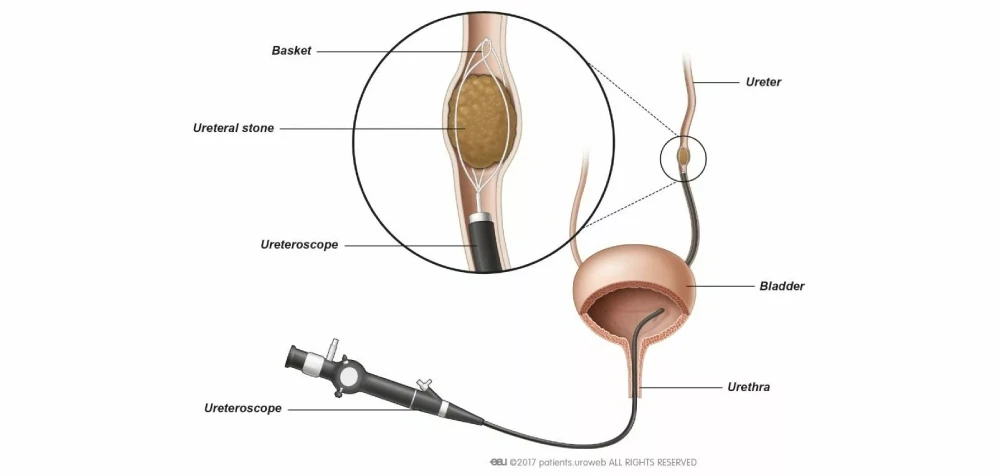
For stones that are stuck, painful, or larger in size, Dr. Ajinkya Kasekar performs URS with laser fragmentation, where:
A thin scope is passed through the urinary passage
The stone is visualized directly
A laser is used to break the stone into small pieces
Fragments are removed or allowed to pass naturally
No cuts and minimal recovery time.
3. DJ Stent Placement
Sometimes a stent may be placed to:
Relieve blockage
Reduce pain
Allow the stone to pass
Prepare for ureteroscopy
4. ESWL (Shock Wave Treatment)
In selected cases, especially for upper ureteric stones, external shock waves can be used to break the stone into smaller pieces.
Suitability depends on the stone’s size, density, and location.
Surgical intervention is recommended if:
The stone is >6 mm
Severe pain persists
Infection is present
Stone is stuck or obstructing urine flow
Kidney function is affected
Prompt treatment prevents long-term damage.
Most patients:
Go home the same day
Resume normal activities within 1–2 days
Experience quick relief from pain
Require follow-up for stent removal (if placed)
Expertise in advanced endoscopic stone treatment
High success rates with laser ureteroscopy
Minimal pain and fast recovery
Clear and ethical medical guidance
Modern facilities and advanced surgical instruments
Experienced in handling complex or recurrent stones
If you are experiencing pain or symptoms of a ureteric stone, early treatment ensures fast relief and protects kidney health.
Meet Dr. Ajinkya Kasekar for accurate diagnosis and advanced ureteric stone treatment.
Urinary Problems in Male and Female Patients What Are Urinary Problems? Urinary problems refer to …
RIRS with laser removal RIRS (Retrograde Intrarenal Surgery) with laser lithotripsy is one of the …
PCNL (Percutaneous Nephrolithotomy) PCNL (Percutaneous Nephrolithotomy) is an advanced, minimally invasive surgical procedure used to …
URS with laser removal URS (Ureteroscopy) with laser lithotripsy is a highly effective, minimally invasive …

Dr. Ajinkya Kasekar is a trusted urologist in Mumbai, offering comprehensive care for kidney stones, prostate disorders, urinary infections, incontinence, and reconstructive urology using modern, minimally invasive techniques.